Complications and regret
What should you know about facelift complications and revision before surgery?

Haematoma, poor scarring and temporary nerve dysfunction are reported most often.[1] A 67-study meta-analysis put motor nerve injury at 0.66%, permanent at 0.047%.[2] Smoking, blood pressure and medicines can be addressed with the surgeon before surgery.[3]
Written by the Facelift in Seoul editorial team from the sources listed on each page. Last updated: .
Which facelift complications are reported most often?
A systematic review of facelift studies from 2000 to August 2024 found haematoma to be the complication reported most often. It described overall complication rates as low.[1]
In the studies from 2012 onwards, haematoma was followed by unfavourable scarring, temporary nerve dysfunction and seroma, a collection of fluid under the skin.[1]
A haematoma is blood collecting under the skin; it can prolong swelling or lead to skin necrosis. Among 1,078 consecutive facelift patients (1994–1999), 45 haematomas occurred (4.2%).[4]
If swelling or tightness of the face or neck increases suddenly, or pain worsens sharply, contact the surgical team urgently.The Aesthetic Society aftercare guidance, checked 4 November 2026
Is facial weakness or numbness after a facelift temporary?
A meta-analysis of 67 studies (15,404 patients) estimated motor nerve injury, which affects facial movement, at 0.66% and sensory nerve injury at 0.39%. Estimates for permanent injury were 0.047% and 0.045%.[2]
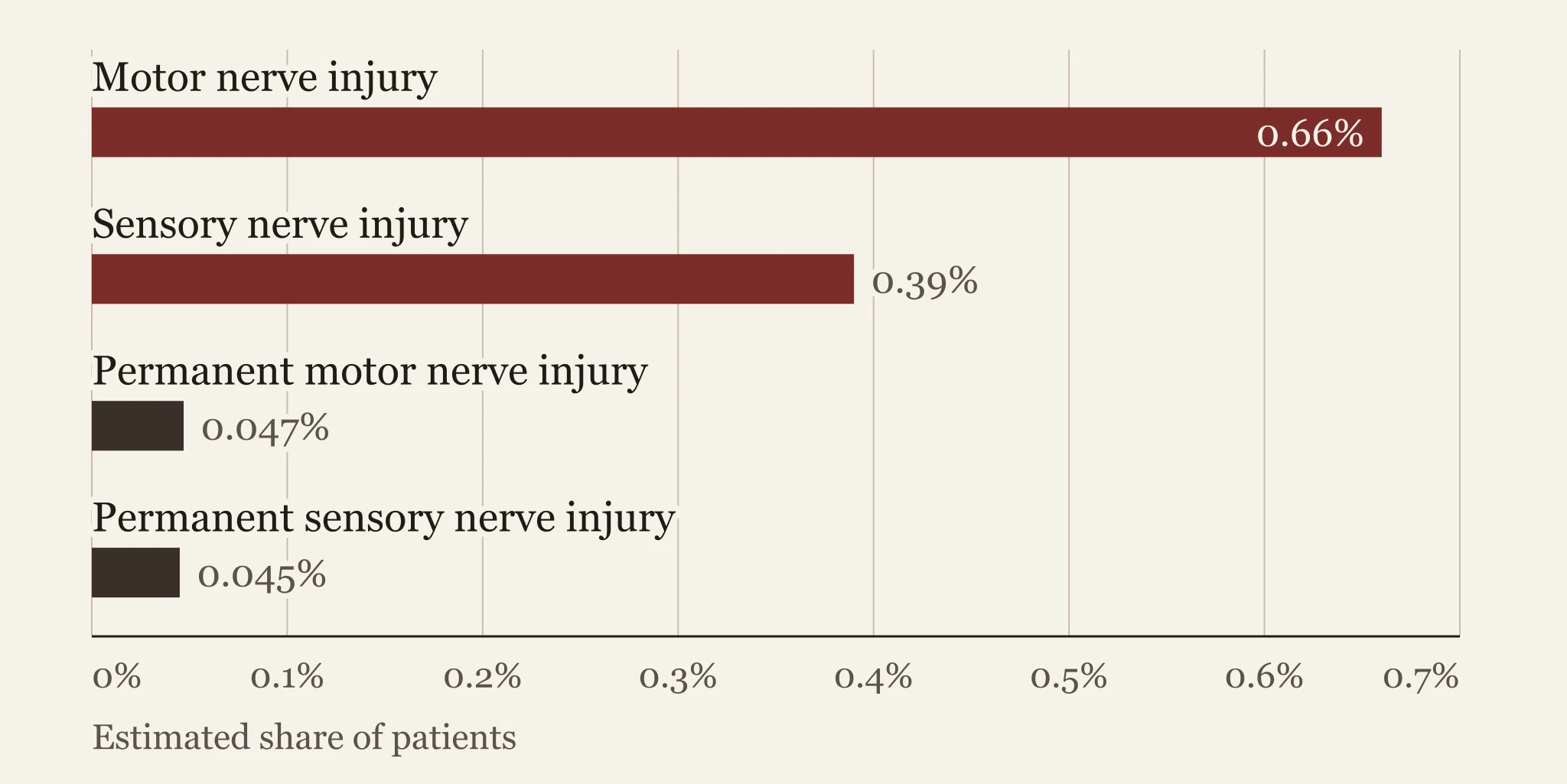
Its authors note that most sensory nerve injuries recover on their own within a year and that permanent deficits are rare.[2] For the numbness of normal healing, see recovery and days in Seoul.
Can a facelift change scars, earlobes (pixie ear) or the hairline?
Unfavourable scarring is among the complications reported most often. Scar management starts with closing the wound under low tension.[1][5] For incision routes and how scars mature, see facelift scars and their care.
NHS guidance lists a raised hairline or sideburns among facelift risks. Before surgery, check where the temple and behind-the-ear incisions will sit with your usual hairstyle.NHS facelift guidance, checked 4 November 2026
A change in earlobe shape after a facelift, known as pixie ear, is listed among the deformities of a first facelift that revision surgery is done to correct. Ask how the incision and closure around the earlobe are planned.[6]
Which changes settle with time, and which lead to revision?
An article on the ASPS site says swelling, tightness and altered sensation can take up to a year to settle. Judge the result at follow-up, not in the first weeks.ASPS recovery timeline article, checked 4 November 2026
The literature separates a secondary facelift, done years after a satisfactory first operation as ageing returns, from a revision, which is done to correct unsatisfactory results, complications or deformities of the first surgery.[6]
A systematic review of 14 studies (737 patients) on second facelifts found them done about 9–12 years after the first. The anatomy had changed, with a thinner SMAS (the layer beneath the skin), fibrosis and scarred tissue planes.[6]
Complication rates in cohort studies ranged from 2.0% to 21.1% and were comparable to first facelifts overall. An unnatural appearance or unbalanced features are among the reasons people seek another facelift.[6]
Which risk factors can be addressed before surgery?
The 1,078-patient series linked haematoma to anterior platysmaplasty, higher systolic pressure, male sex, aspirin or anti-inflammatories, and smoking. Blood pressure and medicines, including blood thinners, are checked first.[4][3]

Major skin necrosis is rare. Reported triggers include smoking, thinly raised skin, excessive tension, an undrained haematoma and wide undermining beyond the nasolabial folds; smoking is the commonest preoperative risk factor.[3]
Stopping smoking before surgery reduces the risk of wound-healing problems, but how far ahead to stop is not known. Agree the timing with the surgeon.[3]
A meta-analysis of 183 studies grouped by technique reported the differences below against SMAS plication. Its authors advise against choosing a technique on complication rates alone.[7]
| Complication | Higher than SMAS plication after (rate with that technique) |
|---|---|
| Temporary nerve injury | High lateral SMAS (1.85%), composite (1.52%) |
| Permanent nerve injury | No difference between techniques |
| Major haematoma | Deep plane (1.22%), SMAS imbrication (1.92%) |
| Skin necrosis | SMAS flap (1.57%) |
What should you ask in consultation to reduce regret?
Before deciding, read about unwanted results and revision after a facelift and take these questions to the consultation.
Which tissues will you move in my face, and in which direction?
Why it matters. An unnatural appearance is one of the reasons people seek another facelift.
What a good answer includes. The plan names the skin, SMAS and neck work, with direction and extent.
Treat with caution. You hear only about a 'strong lift', with no plan for each layer.
What will we adjust before surgery to lower the risk of haematoma?
Why it matters. Blood pressure, medicines and smoking were linked to haematoma.
What a good answer includes. Blood pressure checks, which medicines to stop and when, and the timing for stopping smoking are written down.
Treat with caution. No one asks about your health conditions or medicines.
Where will the incision run around my earlobe and hairline?
Why it matters. Earlobe shape and hairline position can change after a facelift.
What a good answer includes. The lines are drawn on your skin with your usual hairstyle in mind.
Treat with caution. You are told only that the scar will be 'hidden', and no line is drawn.
Who will see me if a complication occurs, in Seoul and after I fly home?
Why it matters. Haematoma and facial weakness need prompt assessment and treatment.
What a good answer includes. You receive contact details, appointment dates and a plan for after departure.
Treat with caution. No contact route is given after discharge.
Questions about facelift complications and regret
What counts as a failed facelift?
The term is used for complications such as haematoma, nerve injury or poor scarring, and for results that look unnatural or unbalanced. Unnatural or unbalanced results are also reported as reasons people consider revision.[1][6]
How can I lower the risk of regret before a facelift?
Stop smoking, and review blood pressure and medicines with the surgeon. Before you agree, ask to see which tissues will be moved and where the incisions will run.[3]
Can a failed facelift be revised?
Revision surgery is done to correct unsatisfactory results, complications or deformities such as pixie ear. By contrast, in studies of second facelifts done years later, tissue was thinner and scarred, but complication rates were comparable to first facelifts.[6]
How long does numbness last after a facelift?
Altered sensation around the incisions can last weeks or months.MedlinePlus facelift guidance, checked 4 November 2026 When it is reported as a sensory nerve injury, most cases recover on their own within a year.[2]
Is there a best age for a facelift?
In one surgeon's 10-year series of 541 consecutive facelift patients, age, including over 75, was not linked to complications. Patients were strictly screened, and age alone was not an independent predictor of complications.[8]
References
(8)
Bibliographic records retrieved from PubMed (U.S. National Library of Medicine).
Fang AH, de la Torre J. A Systematic Review of Rhytidectomy Complications and Prevention Methods: Evaluating the Trends. Ann Plast Surg. 2025;94(6S Suppl 4):S502-S516.
Gandra G, Silva BS, Horta R. Facelift Surgery and Nerve Injury: A Systematic Review and Meta-Analysis. Aesthetic Plast Surg. 2025;49(20):5696-5711.
Sinclair NR, Coombs DM, Kwiecien G, et al. How to Prevent and Treat Complications in Facelift Surgery, Part 1: Short-Term Complications. Aesthet Surg J Open Forum. 2021;3(1):ojab007.
Grover R, Jones BM, Waterhouse N. The prevention of haematoma following rhytidectomy: a review of 1078 consecutive facelifts. Br J Plast Surg. 2001;54(6):481-6.
Commander SJ, Chamata E, Cox J, et al. Update on Postsurgical Scar Management. Semin Plast Surg. 2016;30(3):122-8.
Saad C, Ishak R, Joumaa JP, et al. Challenges and complications in secondary rhytidectomies, a systematic review. JPRAS Open. 2026;51:82-91.
Jacono AA, Alemi AS, Russell JL. A Meta-Analysis of Complication Rates Among Different SMAS Facelift Techniques. Aesthet Surg J. 2019;39(9):927-942.
Vishwanath N, Mandelbaum M, Williams-Medina E, et al. Effect of Age on Complications in Facelift Surgery. Aesthet Surg J. 2026;46(9):NP99-NP109.